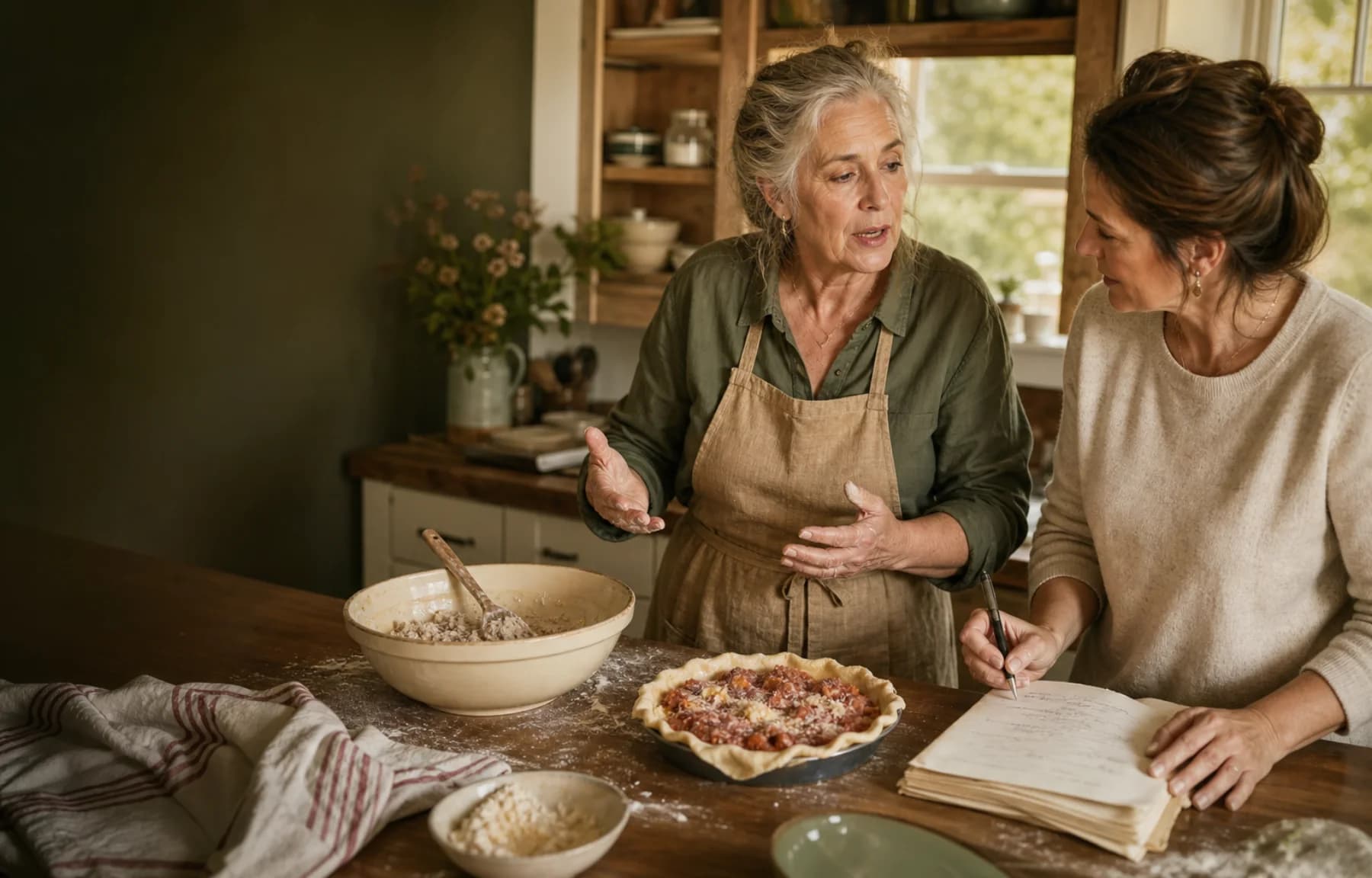
When an experienced cook says ‘a handful’ or ‘until it looks right,’ they are not necessarily being vague. Their hand, pan, flame, dough, and memory form a measuring system built through repetition. Your job is to make that system visible—not replace it with invented precision.
Use measurement as a bridge. Capture the cook’s words, observe the action, measure what actually happened, and keep the sensory cue that tells future cooks when the number needs adjustment.
The four-part method
- Record the original phrase.
- Observe the ingredient or action in context.
- Measure without interrupting the cook’s normal movement.
- Confirm the number and preserve the sensory decision beside it.
1. Do not translate the phrase too early
Write exactly what was said: ‘one good handful,’ ‘the blue cup,’ ‘flour until it takes no more,’ or ‘cook until the noise changes.’ Ask what the phrase controls. A handful may describe a rough quantity; ‘until it takes no more’ may describe hydration; a sound may mark evaporation.
If you immediately convert ‘handful’ to a number, you may measure the wrong thing. First identify the ingredient, starting quantity, batch size, equipment, and desired result.
2. Measure through the action
Place an empty bowl on a scale, tare it, and let the cook add the normal handful. For a familiar cup, fill it as usual and transfer the contents to a marked jug or scale. For oil, pour into a light container before it reaches the pan when that does not disrupt the method.
Repeat variable measures more than once if the cook is willing. The useful result may be a range rather than a single value. Record whether the ingredient was packed, level, heaped, chopped, sifted, hot, or cold.
- Photograph the cup or spoon beside a ruler.
- Record ingredient weight rather than assuming equal volumes weigh the same.
- Note batch size every time.
- Do not handle hot oil, boiling syrup, or unsafe equipment merely to obtain a number.
3. Turn ‘right’ into observable signals
Ask the cook to describe the change using sight, sound, touch, smell, and movement. ‘Golden’ becomes more useful when paired with ‘brown only at the edges.’ ‘Thick’ becomes clearer as ‘the spoon leaves a path that closes after two seconds.’
Use time and temperature as context, not the sole command. Home ovens, pans, ingredient moisture, and batch size vary. A future cook needs both an expected range and the signal that wins when conditions differ.
| Family phrase | Useful follow-up | Cookable wording |
|---|---|---|
| Until it looks right | What changes first? | Cook until the edges turn amber and the centre remains pale |
| A slow oven | Which setting and rack? | Bake at about 160°C on the middle rack |
| Enough flour | How does the dough behave? | Add 30–50 g, stopping when dough releases from the bowl |
| A good pinch | Can we weigh three pinches? | About 1–2 g, then adjust to taste |
4. Read the instruction back and test it
Offer the measured wording as a question: ‘Would you say about 40 grams, but stop sooner if the dough stops sticking?’ The cook may explain that weather, flour, or egg size changes the amount. That explanation belongs in the recipe.
Ask another person to follow the written version. If they reach the correct texture using 35 g instead of 42 g, the recipe should express the range and the stopping cue—not insist that the observed session was universally exact.
- 1
Source
Keep the original phrase and recording.
- 2
Observation
Write what happened in this specific batch.
- 3
Instruction
Give a useful range plus the sensory decision.
- 4
Verification
Have the cook approve and another person test.
5. Use this measurement worksheet
For every uncertain quantity, record: original words; ingredient and preparation; usual container or hand; observed weight or volume; number of observations; batch yield; equipment; sensory stop signal; acceptable range; substitutions; cook’s approval; test result.
Leave an item unresolved when evidence is weak. ‘Quantity still to confirm’ protects the family record better than a plausible number borrowed from another recipe.
Questions about recipes made by feel
Are grams always better than cups?
Weight is often easier to reproduce for flour and other variable ingredients, but the familiar cup may matter to the story. Keep both when useful and confirmed.
How many times should we measure a handful?
Three ordinary repetitions can reveal whether the measure is stable or a broad range. Do not turn the session into a laboratory if it makes the cook uncomfortable.
What if testing changes the family recipe?
Keep the observed family version and label any tested adaptation separately. The goal is clarification, not replacing the source with the editor’s preferred method.
Can we estimate from a similar online recipe?
Use outside recipes only to formulate questions or check safety—not as evidence of what your relative used. An unconfirmed family quantity should remain labelled.
Preserve the number and the judgment
A number tells the next cook where to begin. The family phrase and sensory cue tell them how to finish. Keep all three: original wording, observed range, and the signal that guided the experienced hand.