A family recipe can disappear while everyone still remembers its name. The card survives, but the handwriting fades. The cook is still with you, but the method lives in gestures: a pan judged by sound, dough judged by touch, and quantities measured with one familiar cup.
Good preservation keeps three things together: the original evidence, a version another person can cook from, and the story that explains why the dish matters. This guide gives you a calm workflow for all three. Start with one recipe. A small, checked archive is more valuable than a giant folder nobody can understand.
The short version
- Choose one meaningful recipe and the person who knows it best.
- Keep original cards, photographs, and recordings unchanged.
- Create a separate working transcription that the cook can correct.
- Capture quantities, sensory cues, substitutions, equipment, and family context.
- Keep at least two digital copies in different places, then make the collection usable through a clear book or shared archive.
1. Choose the first recipe by meaning, not difficulty
Do not begin by emptying every drawer onto the table. Pick the dish people request, the one attached to a holiday, or the one only a single person still makes. A defined first recipe lets you learn the process before handling a whole box.
Write down who knows the recipe, who remembers eating it, where any cards or photographs live, and whether the cook would rather talk, cook while being observed, type, or write. Preservation works best when the method respects the person contributing.
- Recipe name, including family nicknames or alternate spellings
- Primary cook and anyone else who can check details
- Occasions when the dish appears
- Known source materials: cards, notebooks, photographs, videos, menus, or utensils
- A realistic date for one recording or cooking session
2. Capture originals without replacing them
Photograph or scan every side of a recipe card, including blank-looking backs, margins, envelopes, and clipped notes. A grease mark, a changed quantity, or a different handwriting can explain how the recipe evolved. Keep the first digital capture as an untouched master instead of repeatedly editing the only copy.
For fragile paper, avoid forcing pages flat or removing attached pieces. Use even, indirect light and support the item. If the original is valuable, mouldy, stuck together, or actively crumbling, stop and ask a paper conservator or archive for advice rather than experimenting with tape, cleaners, or lamination.
3. Record the cook in the way they naturally remember
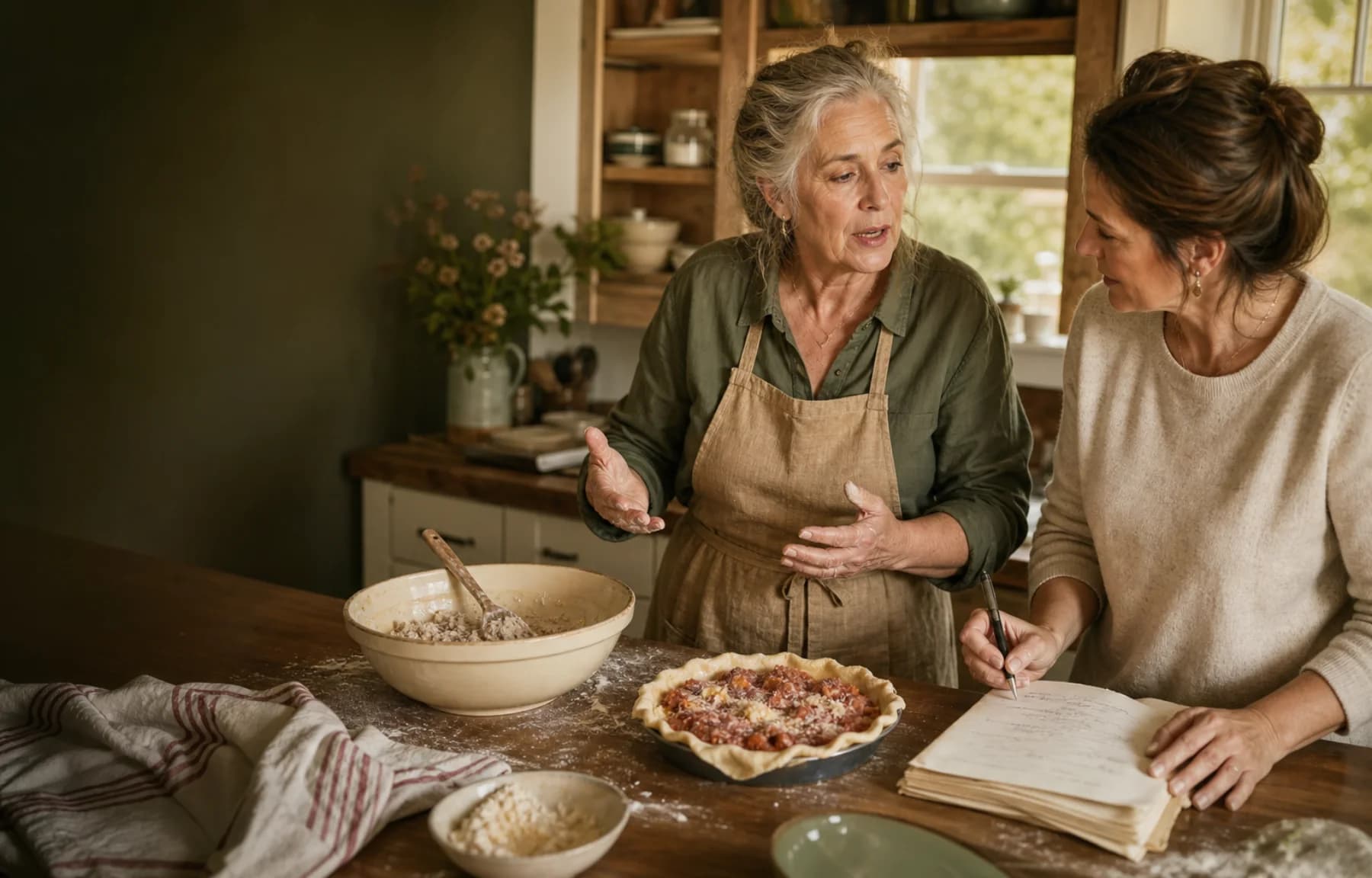
A blank recipe form can make an experienced cook feel as if they are taking an exam. Let them tell the recipe as a story or cook it in their normal order. Record audio or video only with clear permission, explain who will see it, and make stopping easy.
Do not interrupt every sentence to force recipe structure. Mark uncertain details and return to them after the first telling. People often remember an omitted ingredient when they describe the smell, the pan, the person who taught them, or what happens immediately before serving.
- Ask what the dish should look, smell, sound, and feel like at key moments.
- Ask which pan, cup, spoon, oven, or stove the cook normally uses.
- Ask what can change and what would make it a different dish.
- Ask what beginners usually get wrong.
- Keep pauses, uncertainty, and family wording in the source recording; resolve them in the working recipe, not by altering the evidence.
4. Build a cookable copy without erasing the family voice
Create a working recipe beside the original. Separate ingredients from method, put steps in cooking order, and state yield, equipment, temperatures, and timings when known. Preserve distinctive language in a headnote, quoted cue, or family note instead of making instructions vague for the sake of nostalgia.
Never invent a missing quantity or food-safety instruction. Label uncertainty plainly: ‘Elaine remembers using about half the blue cup; measure not yet confirmed.’ Then ask the cook, compare the actual cup, or test the recipe with permission. A documented unknown is safer and more honest than confident guesswork.
| Layer | What belongs there | Example |
|---|---|---|
| Original | Unedited card, audio, photograph, or video | ‘Add the little blue cup’ |
| Checked recipe | Confirmed ingredients and ordered method | ‘Add about 165 ml broth gradually’ |
| Family note | Voice, memory, and context | ‘Listen for the hard sizzle to soften’ |
| Open question | Anything not yet supported | ‘Was the oven fan-assisted?’ |
5. Preserve context another generation will need
Ingredients alone do not explain why a recipe belongs to a family. Record the person associated with it, the place and period, celebrations or ordinary meals, changes caused by migration or availability, and disagreements about the ‘right’ version. Different versions can coexist when attribution is clear.
Add photographs with names, approximate dates, locations, and the name of the person who supplied them. ‘Kitchen photo’ becomes nearly meaningless over time; ‘Elaine Carter making Sunday gravy in Newark, around 1988, supplied by Maria Carter’ can still be understood decades later.
6. Review with the cook, then test for a new cook
First ask the original cook to check meaning, not grammar. Read the method aloud if reading a long page is tiring. Confirm names, quantities, sequence, and which personal details may be shared. Let the cook keep their own phrasing where it remains clear.
Then ask someone less familiar with the dish to cook from the written version without coaching. Note every point where they hesitate. This is not a test of the person; it is a test of the instructions. Return questions to the cook instead of silently ‘fixing’ their recipe.
- 1
Meaning check
Does the recipe say what the cook intended?
- 2
Cookability check
Can another person follow it without hidden family knowledge?
- 3
Permission check
Is everyone comfortable with the names, images, stories, and recordings included?
- 4
Version check
Can the family tell which source and revision produced the current recipe?
Questions families ask
Should I laminate old recipe cards?
Avoid irreversible treatments without professional advice. Lamination can change or damage paper and makes later conservation harder. Capture the card digitally and use an archival-quality enclosure suited to its condition.
Is a phone photograph good enough?
It can be a useful access copy when the whole item is sharp, evenly lit, colour-accurate, and photographed front and back. Significant or fragile originals may benefit from careful scanning or professional help.
What if two relatives remember different versions?
Keep both and attribute them. Record who made each version, when, and what changed. Variation is part of family history, not necessarily an error.
Can AI fill in missing ingredients?
It can suggest questions or organize supported information, but it should not silently invent family facts, quantities, or safety-critical steps. Ask the cook, label the gap, or test a proposed version separately.
Do we need to publish the recipes online?
No. A private digital archive and print-ready family book can preserve and share the collection without making personal stories, voices, or photographs public.
Responsible preservation references
Preservation succeeds when somebody can use what you saved
Do not wait for a perfect archive plan. Choose one recipe, preserve its evidence, listen to the person behind it, and produce one checked version another relative can cook. That first complete loop will teach you how to handle the next recipe with more care and less effort.