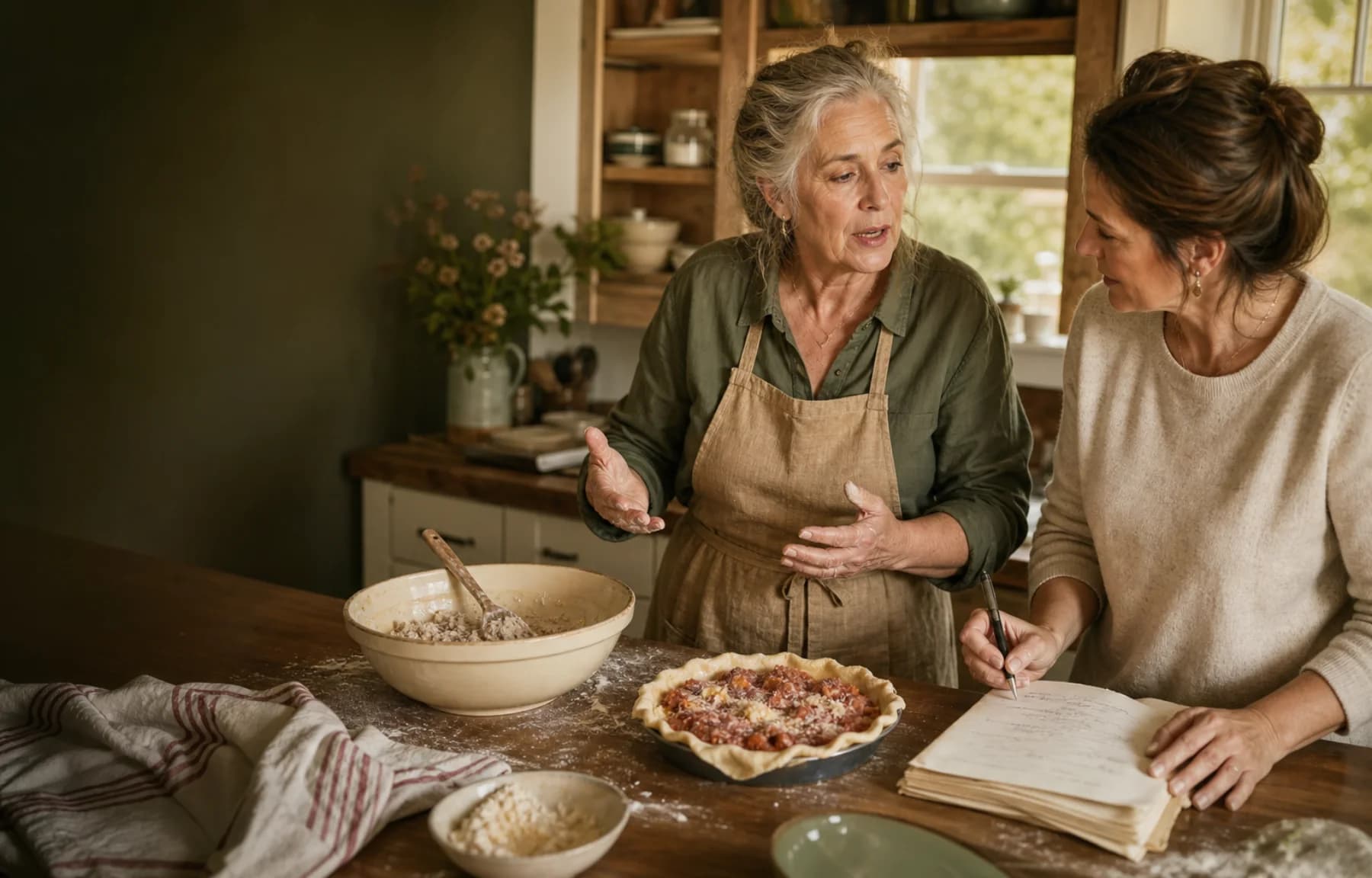
The best recipe interview does not sound like a questionnaire. Pick one dish, sit somewhere comfortable, and follow the cook’s memory. Use these questions as prompts, not a script. Five thoughtful answers are better than thirty rushed ones.
Ask permission before recording. Explain who will hear the conversation and whether stories or photographs may appear in the family book. If the person becomes tired, finish the recipe basics and leave memories for another day.
A comfortable interview setup
- Choose one recipe and allow 30–45 unhurried minutes.
- Let the first telling flow before resolving missing quantities.
- Ask open questions, then use specific follow-ups about actions and senses.
- Do not correct memories during the conversation; note differences for later review.
- End by reading back what you understood and agreeing on the next check.
1. Begin with the dish and its origin
Names and origins help later readers distinguish a family version from a generic dish. If nobody knows the beginning, write ‘family remembers it from at least…’ rather than inventing a precise lineage.
- What do you call this dish, and has the family used any other name for it?
- Who taught you to make it, and where did they learn?
- What is your earliest memory of eating or watching it being made?
- Was it everyday food, celebration food, or something made during a particular season?
- Has the recipe changed because the family moved, ingredients changed, or somebody preferred it another way?
2. Identify ingredients and quantities
Put the familiar object on a scale or pour it into a marked cup while the cook uses it. Keep their phrase beside the measured amount: ‘one blue cup, about 165 ml.’
- Which ingredients are essential, even if you usually leave them off a written list?
- What does your usual cup, glass, spoon, handful, or packet hold?
- Which brand, variety, cut, ripeness, or fat content changes the result?
- What can be substituted, and what substitute has disappointed you?
- How many people does your normal batch feed, and what do you do with leftovers?
3. Recover the actions that experienced cooks skip
Ask the cook to mime or demonstrate a difficult movement. Words such as fold, work, beat, brown, and enough can represent very different actions in different kitchens.
- What do you prepare before turning on the heat?
- Which pan, pot, knife, mixer, tray, or oven position do you use?
- What order do ingredients enter, and which steps must not be rushed?
- Do you rest, chill, soak, preheat, drain, reserve, or reheat anything that is easy to forget?
- Where would a new cook need more detail than you do?
4. Ask how the cook knows
These answers often carry the real expertise. Record the time as a range and the sensory signal as the decision: ‘Bake 25–35 minutes, until the centre springs back lightly.’
- What should it look like before you move to the next step?
- Is there a sound that tells you the pan, syrup, dough, or sauce is ready?
- What texture should you feel with the spoon, fingers, or knife?
- Which smell means it is ready, and which smell means it has gone too far?
- If the clock and the food disagree, which signs do you trust?
5. Learn the rescue moves and boundaries
Keep family experience distinct from authoritative food-safety guidance. If storage or doneness is uncertain, mark the question and verify it through an appropriate official source rather than guessing.
- What usually goes wrong the first time somebody makes this?
- How can you tell early that something is wrong?
- Can it be rescued, and what do you do?
- What should never be changed because the result becomes unsafe or stops being this dish?
- How do you store, freeze, transport, and reheat it?
6. Preserve the meaning around the recipe
Finish by asking what should stay private. A moving story is not automatically permission to publish it. Let contributors choose whether a detail belongs in the recipe, a private recording, or nowhere in the book.
- Who always asked for this dish, and what did they say about it?
- Which kitchen, table, celebration, journey, or difficult period do you associate with it?
- Is there a utensil, serving dish, apron, note, or photograph connected to the recipe?
- What do you hope a younger family member understands when they make it?
- Whose version should we record next, and what might they remember differently?
Interview questions about the interview
Should we cook during the interview?
Cooking reveals gestures, equipment, order, and sensory cues that a seated conversation may miss. A first conversation followed by one cook-along often works best.
What if my grandparent does not remember quantities?
Use their usual utensils, weigh ingredients as they pass through the hand or cup, and record sensory decisions. Do not pressure them to produce false precision.
Can several relatives join?
Yes, but name who remembers each detail and prevent louder voices from overwriting the primary cook. Conflicting versions can be reviewed separately.
Should I transcribe every word?
Keep the source recording if permitted. The working recipe can be concise, while characteristic phrases and stories move into a family note.
One good follow-up is worth ten generic questions
Listen for uncertainty, gestures, and phrases such as ‘until it changes.’ Ask what changes. That is where a family recipe often moves from memory into instructions another person can trust.